The independent organizations (a.k.a. silos) shown in Figure 1 typically implement their business processes on different computer systems (Unix, Windows, mainframes), on different platforms (J2EE, .NET) and with different vocabularies. Yet, they all need to communicate in a way that serves, in this case, a trauma victim at the time of his or her emergency, researchers who will later study cohorts of this trauma victim, and sundry others (most of whom are not shown in the simplified model).
This post will discuss an Electronic Health Record (EHR)-centric system implemented with a Service-Oriented Architecture (SOA) -- the business industry’s de facto standard for interoperability. The functions of this system are data collection, management and distribution for both the immediate situation and long term health care experiences.
I’ll address some of the challenges (and opportunities) of technical interoperability, holding off ‘til later posts any discussion of semantic interoperability.
Note: This rather lengthy post is not and is not meant to be a palimpsest on SOA. But, I have included a number of references (links to references) for anyone looking for a more detailed account of this topic.

Figure 1
Figure 2 shows a traditional implementation of the system shown in the use case drawn in Figure 1. When a change -- virtually any change -- is made in one part of this interconnected system, the overall system usually stops working, until system-wide adjustments are made. In short, the figure below shows a system that’s “hard wired.”
Note: For simplicity, these figures and this discussion omit a number of real-world details: for example, the voice communication often employed by police and EMS teams.

Figure 2
To remedy this problem, a new architecture, that of Service-Oriented Architecture (SOA), was devised. An SOA implementation of the system shown in the use case is outlined in Figure 3. At first glance, the SOA-based system might seem more complicated than the system shown in Figure 2. But, as the following discussion will attempt to show, it isn’t.

Figure 3
Note: The major part of this post will be based on a Web services implementation of SOA. However, before concluding this post, I’ll address the oft-heard view that SOA is now “dead.” SOA is indeed alive and kicking in many organizations.
The system in Figure 2, if fleshed out, would move toward becoming the fully connected system shown below (in practice, very few systems are fully connected). In such a system of computer applications, when one node is changed, all other nodes that connect to it would need a new interface to the changed node.
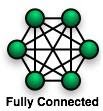
As shown, in a fully connected network with n nodes, there are n x (n-1) / 2 direct paths. That means 15 connections for 6 nodes, 45 connections for 10 nodes, etc.
In contrast, each node in the system in Figure 3 has only one connection – that to a bus, as represented in the figure below.
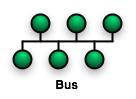
Service-Oriented Architecture
SOA relies on services exposing their functionality via interfaces that other applications and services can read to understand how to utilize those services.
This style of architecture promotes reuse at the macro (service) level rather than micro (classes) level. It can also simplify interconnection to – and usage of – existing IT (legacy) assets.
Designers can implement SOA using a wide range of technologies, including SOAP, REST, DCOM, CORBA, or Web Services. (I gave a brief overview of DCOM, CORBA and Web Services in my June 16 post and will discuss REST below.) The key is independent services with defined interfaces that can be called to perform their tasks in a standard way, without a service having foreknowledge of the calling application, and without the application having or needing knowledge of how the service actually performs its tasks.
Albeit in the distant past, I’ve used the Oracle SOA Suite to federate a unified system out of the disparate systems shown in the figures.
This suite, which includes JDeveloper, a robust Java IDE, is by no means the only solution; there are others, both proprietary and open source! For example,
Proprietary: http://i.zdnet.com/whitepapers/cape_clear_Principles_of_BPEL.pdf
Open source: http://orchestra.ow2.org/xwiki/bin/view/Main/
However, the Oracle SOA Suite is a complete set of service infrastructure components for creating, deploying, and managing services. It enables services to be created, managed, and orchestrated into composite applications and business processes. Additionally, you can adopt it incrementally on a project by project basis and still benefit from the common security, management, deployment architecture, and development tools that you get out of the box.
This Suite is a standards-based technology suite that consists of the following:
* Oracle BPEL Process Manager to orchestrate services into business processes
* ESB to connect existing IT systems and business partners as a set of services
* Oracle Business Rules for dynamic decisions at run time that can be managed by business users or business analysts
* Oracle Application Server Integration Business Activity Monitoring to monitor services and disparate events and provide real-time visibility into the state of the enterprise, business processes, people, and systems.
* Oracle Web Services Manager to secure and manage authentication, authorization, and encryption policies on services that is separate from your service logic
* UDDI registry to discover and manage the life cycle of Web services.
* Oracle Application Server that provides a complete Java 2, Enterprise Edition (J2EE) environment for your J2EE applications.
For an overview of the soon-to-be-released Version 11, see
http://www.oracle.com/technology/products/ias/bpel/techpreview/2008-05-01-whats-new-in-oracle-soa-suite-tp4.pdf
Business Process Execution Language (BPEL)
One of the key standards accelerating the adoption of SOA is Business Process Execution Language (BPEL) for Web Services. BPEL enables organizations to automate their business processes by orchestrating services (thus enabling developers to build end-to-end business processes spanning applications, systems, and people in a standard way). Existing functionality is exposed as services. New applications are composed using services. Services are reused across different applications. Services everywhere! For an account of Orchestration versus Choreography, see http://www.oracle.com/technology/pub/articles/matjaz_bpel1.html
BPEL has emerged as the standard for process orchestration enabling you to build end-to-end business processes spanning applications, systems, and people in a standard way.
In the next figure, I show two pallets of drag-and-drop components available in version 10.3 of the SOA Suite for the development of a BPEL process. Version 11 will be availability shortly.
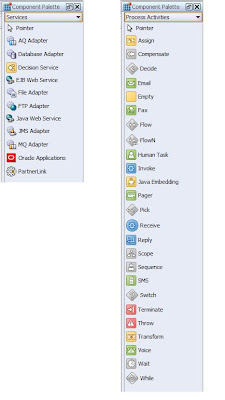
Introduction to the JDeveloper BPEL Designer
http://download-west.oracle.com/docs/cd/B31017_01/core.1013/b28938/design.htm#CHDIJCGH
Enterprise Service Bus
An Enterprise Service Bus (ESB) is an architectural pattern, not a software product. Different software products can form an ESB. In some cases, companies use multiple products in different areas, leveraging specific functionality to meet their unique requirements. These different products can be federated together as the realization of the ESB pattern.


In the next figure, I show two pallets of drag-and-drop components available in version 10.3 of the SOA Suite for the development of an ESB. As I mentioned earlier, Version 11 will be availability shortly.
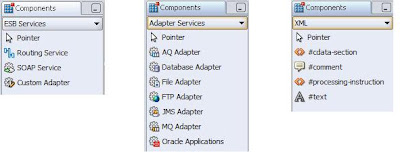
Introduction to the JDeveloper ESB Designer
http://download-west.oracle.com/docs/cd/B31017_01/core.1013/b28938/design.htm#CHDIBCCC
Figure 3 introduced Business Activity Monitoring (BAM) and Business Rules to the architecture
Business Activity Monitoring – BAM satisfies a growing need to enable health care executives, and more specifically operations managers, to improve their decision-making processes by first getting a real time view of the business events occurring in their enterprise, and second using the derived intelligence to analyze and improve the efficiency of their business processes.
Understanding Business Activity Monitoring in Oracle SOA Suite
http://www.packtpub.com/article/business-activity-monitoring-in-oracle-soa-suite
Business Rules – Business Rules is one of the newer technologies (typically run from an application server) and is designed to make applications more agile. A business analyst can change business policies expressed as rules quickly and safely with little or no assistance from a programmer
Using Business Rules to Define Decision Points in Oracle SOA Suite
Part 1. http://www.packtpub.com/article/business-rules-define-decision-points-oracle-soa-suite-part1
Part 2. http://www.packtpub.com/article/business-rules-define-decision-points-oracle-soa-suite-part2
For detailed coverage of the Oracle Service Bus, BPEL Process Manager, Web Service Manager, Rules, Human Workflow, and Business Activity Monitoring. See
Oracle SOA Suite Developer's Guide
http://www.packtpub.com/developers-guide-for-oracle-soa-suite-10gr3/book
and
Getting Started With Oracle SOA Suite 11g R1 – A Hands-On Tutorial
http://www.packtpub.com/getting-started-with-oracle-soa-suite-11g-r1/book
When designing an SOA solution, it's not always clear whether you should use a Web services BPEL process or an ESB mediation flow (or both).
http://www.ibm.com/developerworks/websphere/library/techarticles/0803_fasbinder2/0803_fasbinder2.html
Building Event-Driven Architecture with an Enterprise Service Bus
http://www.oracle.com/technology/pub/articles/jellema-esb.html
Software frameworks
You should keep in mind that interoperability issues between platforms can arise when switching from one protocol to another and one software framework to another. Some examples include SOAP, REST, the .Net Framework, Enterprise Java Beans (EJB), and Java Messaging Service (JMS).
.Net Web services running over HTTP can be called in three different ways: HTTP GET operation, HTTP POST operation, and SOAP. The GET and POST operations are useful if you need to call a Web Service quickly and no SOAP client is readily available. You can use REST to perform GET, POST, PUT, and DELETE operations over the HTTP in a Perl script. In this script, you can specify SQL queries and simple message queues.
For a discussion of SOAP/REST in the .NET (Visual Studio 2008 SP1) ecosystem, see
http://www.pluralsight.com/community/blogs/scottallen/archive/2008/08/11/visual-studio-sp1-and-the-metification-of-rest.aspx
and
http://msdn.microsoft.com/en-us/library/dd203052.aspx

Often, services within an organization’s firewall are REST-based, while 3rd party partners use a mix of SOAP and HTTPS protocols to access their public services. By using REST for internal services, organizations are avoiding some of the overhead that the WS-* standards introduce.
If the SOAP client is available, here's how to make a simple choice between REST and SOAP. If the application is resource-based, choose REST. If the application is activity-based, opt for SOAP. Under REST, a client might request that several operations be performed on a series of resources over the HTTP. For SOAP-based requests, only one invoke operation is needed for each activity-oriented service that a client might request be performed.
REST requests do not depend on WSDL as SOAP requests do. Yet, REST and SOAP can co-exist as requests from a composite Web service application to an external Web service.
When to use REST based web services?
http://oracled.wordpress.com/2009/03/11/when-to-use-rest-based-web-services/

When Web services are outside the control of the organization (as in the figures at the top of this post), you need to ensure that they can interoperate externally with one another with respect to shared semantics and contractual obligations. Semantic misunderstandings and contractual loopholes contribute to interoperability problems between external enterprise Web services. Future posts will focus on these aspects of interoperability.
For presentations that includes the pros and cons of different protocols (SOAP and HTTP) and software frameworks (.NET and J2EE), see
http://www.esri.com/events/devsummit/pdfs/keynote_chappell.pdf
and
http://www.esri.com/events/devsummit/sessions/keynote.html
The oft-heard view that SOA is now “dead”
Once thought to be the savior of IT, SOA instead turned into a great failed experiment -- at least for many organizations. SOA was supposed to reduce costs and increase agility on a massive scale. In many situations, however, SOA has failed to deliver its promised benefits.
Yet, although SOA is understandably purported to be dead by many, the requirement for a service-oriented architecture is stronger than ever.
Adopting SOA (i.e., application re-architecture) requires disruption to the status quo. SOA is not simply a matter of deploying new technology and building service interfaces to existing applications; it requires redesign of the application portfolio. And it requires a massive shift in the way IT operates. The small select group of organizations that has seen spectacular gains from SOA did so by treating it as an agent of transformation. In each of these success stories, SOA was just one aspect of the transformation effort. And here’s the secret to success: SOA needs to be part of something bigger. If it isn’t, then you need to ask yourself why you’ve been doing it.
The latest shiny new technology will not make things better. Incremental integration projects will not lead to significantly reduced costs and increased agility. If you want spectacular gains, then you need to make a spectacular commitment to change.
Note: As of 2008, increasing numbers of third-party software companies offer software services for a fee. In the future, SOA systems may consist of such third-party services combined with others created in-house.
More on this can be found in “WOA: Putting the Web Back in Web Services.”
http://blogs.gartner.com/nick_gall/2008/11/19/woa-putting-the-web-back-in-web-services/
Also, here’s a link to one of my earlier articles on SOA
“The Economic, Cultural and Governance Issues of SOA”
http://www.cioupdate.com/reports/article.php/11050_3652091_1/The-Economic-Cultural-and-Governance-Issues-of-SOA.htm


