Showing posts with label iphone. Show all posts
Showing posts with label iphone. Show all posts
Tuesday, December 6, 2011
The Personal Computer Is Dead ?
Saying that the personal computer is dead may or may not be premature. However, I just read an article that makes this assertion, and I'd like to suggest that you read it too.
Click here to read The personal computer is dead by Jonathan Zitttrain. He says in conclusion,
"A flowering of innovation and communication was ignited by the rise of the PC and the Web and their generative characteristics. Software was installed one machine at a time, a relationship among myriad software makers and users. Sites could appear anywhere on the Web, a relationship among myriad webmasters and surfers. Now activity is clumping around a handful of portals: two or three OS makers that are in a position to manage all apps (and content within them) in an ongoing way, and a diminishing set of cloud hosting providers like Amazon that can provide the denial-of-service resistant places to put up a website or blog."

Tuesday, May 17, 2011
Using The jQuery Mobile Framework - Write Once, Publish Anywhere
As described in earlier posts, the emphasis in Dreamweaver CS5.5 is firmly on mobile development and designing for multiple screens. A big part of this capability comes from its inclusion of jQuery Mobile, a sophisticated JavaScript and CSS framework designed to work consistently in all major mobile platforms.
•Apple iPhone/iPod Touch
•Google Android
•RIM BlackBerry/Playbook OS
•Nokia Symbian (retired, but still with over 1 billion users worldwide)
•HP/Palm WebOS
•Microsoft Window Phone 7
Built upon the popular jQuery JavaScript framework, jQuery Mobile lets Web designers and developers build mobile application interfaces quickly and consistently. Dreamweaver CS5.5's jQuery’s mobile strategy can be summarized simply: Delivering top-of-the-line JavaScript in a unified User Interface that works across the most-used smartphone web browsers and tablet form factors.
Click here for an introduction to jQuery from Adobe.
Click here for an introduction to jQuery Mobile from Adobe.
Click here for the jQuery Project site
Click here for the jQuery Mobile Project site
Thursday, August 12, 2010
HTML5 - its support in Dreamweaver CS5, Internet Explorer 9 and elsewhere - Part II
There's been a lot of discussion lately about whether or not the HTML5 video tag is going to replace Flash Player for video distribution on the Web.
Consensus: While the video tag is a big step forward for open standards, the Adobe Flash Platform will continue to play a critical role in video distribution.
Click here for a discussion of this topic in the YouTube context (a pretty significant one).
HTML5 (and CSS3) are works in progress. While some parts of these specs are finished or stable, other parts are still under development or have no current browser support.
Nonetheless, leading development tools, e.g., Adobe's Dreamweaver, have begun to support these technologies. To wit, specs that are stable or that have some level of browser implementation are now seen in the new Dreamweaver CS5 HTML5 Pack. Select the Product Details tab.
While the official specifications are still not yet complete, they are now supported to varying degrees by a number of different desktop browsers – and more importantly by all smartphones using Webkit-based browsers (e.g. iPhone, Android, Nokia WRT, Blackberry OS). Given the recent surge of interest around HTML5, Dreamweaver CS5’s compatibility with HTML5 and CSS3 was updated so you can begin exploring their potential today.
Tuesday, July 13, 2010
Epocrates Mobile Electronic Health Record
Health care delivery is now moving away from a specific location and into a virtual care space, where patient medical records and real-time clinical data will reside.
There has also been a revolution in access to clinical reference material, and physicians and other care providers are moving core scientific knowledge from books to apps. Today’s doctors are no longer what they can memorize.
Throughout this blog, I've been discussing many of the components of Electronic Health Record (EHR) systems that will likely be used in the larger systems installed throughout entire hospitals and regions. However, 50 percent of physicians in the US work in small or solo practices.
The Epocrates EHR is specifically targeting the solo practitioner and the small physician groups, which have different needs from the larger enterprise care facilities that so many EHR providers are pursuing. To that end, Epocrates says that it has "teamed up with a very well known” but still undisclosed practice manager partner, whose software will be integrated into the Epocrates EHR for calendaring, scheduling, appointments, billing and more.
The as-yet-not-released Epocrates EHR app will include the company's drug and safety content and will, they say, meet “meaningful use” and HIPAA compliance requirements.
There are offerings from other vendors such as Microsoft and Symantec too, but I've decided to look at Epocrates Mobile EHR because Epocrates was the first company to introduce a medical app for the iPhone. Furthermore, as seen in the image below, their app is now available for many of the popular hand-held smart devices.


Their fully functioning mobile EHR app will work both when connected and disconnected. It’s not enough to just have a mobile EHR, of course, and it is also a fully featured, web-enabled desktop application, too.
The mobile and desktop versions may have the same functionalities, but the different form factors will likely lead to certain applications being favored on each.
There is a functional parity between their mobile and web interface. The information will be delivered differently and the iPhone version will be used for some use cases more often than the desktop version and vice versa. These two platforms are complementary, so Epocrates is not necessarily "leading" with mobile.
Unlike some mobile “portals” to EHR systems, Epocrates offering is a native app with patient data stored in it.
One differentiator between the Epocrates mobile EHR app and some others is that theirs will be a native app and it will store patient data on the device. Users will interact with the EHR differently from a mobile device vs. a desktop client. The iPhone interface is not ideal for text entry, so they are looking for other ways to get information into the device. The iPhone interface will be used more for things like dictation, while the desktop interface won’t be used for that as much. From a task perspective, though, they are not looking to hobble the handheld interface in any way.
Click here to see new apps from Epocrates
Click here to see the Dragon speech-to-text application on a hand-held device
Epocrates is launching an EHR offering now because of the increase in EHR adoption because of the ARRA deadlines for stimulus fund incentives payments. These external deadlines are encouraging physicians to adopt EHR, making it an ideal time to enter the market.
There are also drivers from the technology perspective as well. It’s a good time to enter the market with a mobile EHR because more clinics have a high penetration of smartphone users. Also, 3G wireless networks now have higher bandwidth – enough to support these kinds of applications. Physicians rarely take note of [mobile] Internet connectivity issues anymore. Note: I've also talked a little about the less-ubiquitous 4G (WiMax) networks in earlier posts.
Epocrates plans to integrate the features of the iPhone, such as the camera, as well as dictation directly into the app, an interesting feature especially in light of the recent announcement by Nuance that they will be shipping a medical transcription application for the iPhone.
Epocrates will also utilize the iPhone’s Push Notification Service to alert doctors of important or timely information (and hopefully not overuse it). Given Epocrates’ depth of knowledge of pharmaceutical formularies, e-prescribing will be built in.
Although the mobile application will synchronize with the web application, it will continue working even when there is no internet connection. Data will be stored on the handheld device in a secure, encrypted manner and synchronize when a connection is available, a real issue for hospitals where there are many “dead” zones. And, there will be condition-based templates for easy entry of clinical information.
There will also be integration with a revenue-cycle platform so physicians can charge and submit codes, through a partnership with a “known” company. Epocrates anticipates they will achieve Certification Commission for Health Information Technology (CCHIT) certification by the time of release. The EHR will be delivered as a software-as-a-service (SAAS) model, meaning the physician will effectively lease, not purchase it.
This could be an attractive low-cost product for solo or small group physicians who do not have complex office staff EHR integration needs. In particular, for the physician who already uses their smart phone for many work activities, the potentially painless transition to using it as the primary interface into their office EHR may be very appealing.
Stay tuned.
Click here to see Epocrates executives at HIMSS 2010
Click here to see Andy Wiesenethal, Kaiser Permanente at HIMSS 2010
As an aside, I'd like to note that when Epocrates Online can be accessed with a browser on which Google's (or other) translation app has been installed, as shown in the image below.

Tuesday, May 25, 2010
HTML5 - its support in Dreamweaver CS5, Internet Explorer 9 and elsewhere
With HTML5, an open Web standard, the browser becomes a first class RIA citizen.
HTML5 is being developed as the next major revision of HTML (HyperText Markup Language), the core markup language of the World Wide Web. HTML5 is the proposed next standard for HTML 4.01, XHTML 1.0 and DOM Level 2 HTML. It aims to reduce the need for proprietary plug-in-based rich internet application (RIA) technologies such as Adobe Flash and Microsoft Silverlight.
The HTML5 video tag is a markup language tag, introduced in the HTML5 draft specification, that adds support for embedding video in an HTML page.
The Adobe Flash Player has been and continues to be widely used to embed video on web sites such as YouTube, since the majority of web browsers have Adobe's Flash Player installed (with controversial exceptions such as the browser on the Apple iPhone and iPad). Now, however, HTML5 video is intended by its creators to become the new standard way to show video online, but has been hampered by lack of agreement as to which video formats should be supported in the video tag.
Rather than relying on the browser plug-in Flash, Apple has adopted HTML5, CSS and JavaScript – all open standards. Apple’s mobile devices now ship with high performance, low power implementations of these open standards.
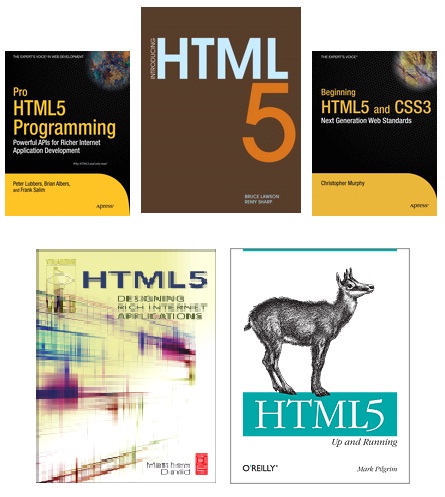
Not to be left out, Adobe has recently added HTML5 support to Dreamweaver CS5. This move should not be viewed only in light of the company's war of words with Apple regarding Flash, but in the other reality that HTML5 is reaching critical mass as evidenced by long-time holdout Microsoft adding HTML5 support to Internet Explorer 9 and a slew of HTML5 books being published by leading houses this summer. I've pictured the covers of a few of them at the end of this post.
These developments come despite the fact that HTML5 is still a work in progress. Even so, HTML5 in Dreamweaver CS5 makes for a mighty application development tool, as shown in the video http://www.youtube.com/watch?v=OEXrd8CR5AY
The HTML5 compatibility pack for Dreamweaver CS5 lets you author CSS3 and HTML5 compatible Web pages for modern browsers. And, of course, it supports the audio and video tags.
Note: The HTML5 extension will work only with Dreamweaver CS5 and not with any of the previous versions.
For more on this new Dreamweaver HTML5 support, check out labs.adobe.com and the following videos:
HTML5 Fundamentals with Dreamweaver CS5 - Semantic Structural Tags - Part 1
HTML5 Fundamentals with Dreamweaver CS5 - Semantic Structural Tags - Part 2
Readers of this blog who are interested in the Semantic Web may find the Part 2 video of particular interest.
HTML5 Fundamentals with Dreamweaver CS5 - Using the Video Tag
Finally, Microsoft will support HTML5 and CSS3 in Internet Explorer 9.0. A developer preview of their next browser can be downloaded from
http://ie.microsoft.com/testdrive/
and click here for a discussion of I.E. 9's support for video content.
Note: There has been a lot of interest and debate about HTML5 and its support for video tags. This release of Internet Explorer provides such support, with tags available for H.264/MPEG4 and MP3/AAC codecs, leaving out support for the open source Ogg Vorbis and Ogg Theora video codecs.

A final note: HTML5 is not likely to displace Adobe Flash videos any time soon. As evidence of this, consider the latest news from Dell: Dell Inc. yesterday unveiled plans for a computer tablet based on Google Inc.’s Android operating system.
Called Streak, the tablet will have a 5-inch screen, Wi-Fi, Bluetooth, and work on a 3G network. Users can download music; interact with social-networking sites; send e-mail, text and instant messages; and make phone calls. It has turn-by-turn navigation with Google Maps, a 5-megapixel camera with flash, and a removable battery.
Streak will have 2 gigabytes of internal storage. Memory can be expanded up to 32 gigabytes allowing it to store as many as 42 movies or 16,000 songs.
Later in the year, the tablet will support Adobe Flash 10.1 — something Apple Inc.’s iPhone, iPad, and iPod Touch devices do not. Flash is widely used for online video.
The Streak is designed to be larger than a smartphone but more portable than a laptop. It is 6 inches wide, nearly 3 inches high, and half an inch thick.
HTML5 is being developed as the next major revision of HTML (HyperText Markup Language), the core markup language of the World Wide Web. HTML5 is the proposed next standard for HTML 4.01, XHTML 1.0 and DOM Level 2 HTML. It aims to reduce the need for proprietary plug-in-based rich internet application (RIA) technologies such as Adobe Flash and Microsoft Silverlight.
The HTML5 video tag is a markup language tag, introduced in the HTML5 draft specification, that adds support for embedding video in an HTML page.
The Adobe Flash Player has been and continues to be widely used to embed video on web sites such as YouTube, since the majority of web browsers have Adobe's Flash Player installed (with controversial exceptions such as the browser on the Apple iPhone and iPad). Now, however, HTML5 video is intended by its creators to become the new standard way to show video online, but has been hampered by lack of agreement as to which video formats should be supported in the video tag.
Rather than relying on the browser plug-in Flash, Apple has adopted HTML5, CSS and JavaScript – all open standards. Apple’s mobile devices now ship with high performance, low power implementations of these open standards.
Not to be left out, Adobe has recently added HTML5 support to Dreamweaver CS5. This move should not be viewed only in light of the company's war of words with Apple regarding Flash, but in the other reality that HTML5 is reaching critical mass as evidenced by long-time holdout Microsoft adding HTML5 support to Internet Explorer 9 and a slew of HTML5 books being published by leading houses this summer. I've pictured the covers of a few of them at the end of this post.
These developments come despite the fact that HTML5 is still a work in progress. Even so, HTML5 in Dreamweaver CS5 makes for a mighty application development tool, as shown in the video http://www.youtube.com/watch?v=OEXrd8CR5AY
The HTML5 compatibility pack for Dreamweaver CS5 lets you author CSS3 and HTML5 compatible Web pages for modern browsers. And, of course, it supports the audio and video tags.
Note: The HTML5 extension will work only with Dreamweaver CS5 and not with any of the previous versions.
For more on this new Dreamweaver HTML5 support, check out labs.adobe.com and the following videos:
HTML5 Fundamentals with Dreamweaver CS5 - Semantic Structural Tags - Part 1
HTML5 Fundamentals with Dreamweaver CS5 - Semantic Structural Tags - Part 2
Readers of this blog who are interested in the Semantic Web may find the Part 2 video of particular interest.
HTML5 Fundamentals with Dreamweaver CS5 - Using the Video Tag
Finally, Microsoft will support HTML5 and CSS3 in Internet Explorer 9.0. A developer preview of their next browser can be downloaded from
http://ie.microsoft.com/testdrive/
and click here for a discussion of I.E. 9's support for video content.
Note: There has been a lot of interest and debate about HTML5 and its support for video tags. This release of Internet Explorer provides such support, with tags available for H.264/MPEG4 and MP3/AAC codecs, leaving out support for the open source Ogg Vorbis and Ogg Theora video codecs.
A final note: HTML5 is not likely to displace Adobe Flash videos any time soon. As evidence of this, consider the latest news from Dell: Dell Inc. yesterday unveiled plans for a computer tablet based on Google Inc.’s Android operating system.
Called Streak, the tablet will have a 5-inch screen, Wi-Fi, Bluetooth, and work on a 3G network. Users can download music; interact with social-networking sites; send e-mail, text and instant messages; and make phone calls. It has turn-by-turn navigation with Google Maps, a 5-megapixel camera with flash, and a removable battery.
Streak will have 2 gigabytes of internal storage. Memory can be expanded up to 32 gigabytes allowing it to store as many as 42 movies or 16,000 songs.
Later in the year, the tablet will support Adobe Flash 10.1 — something Apple Inc.’s iPhone, iPad, and iPod Touch devices do not. Flash is widely used for online video.
The Streak is designed to be larger than a smartphone but more portable than a laptop. It is 6 inches wide, nearly 3 inches high, and half an inch thick.
Thursday, April 15, 2010
Apple’s SDK brouhaha explained for non-developers
So what’s up with Apple this week? In short, they are now the dominant platform in a space, and they intend to maintain that dominant position for as long as possible by preventing the ability to write an application once and run it anywhere. Apple’s tactics for maintaining their dominance are: bullying and complexity. They’re the same tactics use by every computer platform dominator (e.g., IBM, AT&T, and Microsoft) before them. All of this has happened before, and it will happen again. Click here for Brent Noorda's take on Apple’s SDK brouhaha.
An update (5/4/2010):
The Federal Trade Commission and the Department of Justice are exploring whether to open an antitrust inquiry into Apple over its recent actions restricting developers writing apps for its iPhone operating system.
The basis for a potential antitrust probe stems from Apple’s recent changes to its iPhone software developer kit. The changes, which were quietly rolled out during the announcement of the company’s new iPhone 4.0 operating system, made it clear that Apple would no longer allow apps into the iTunes iPhone and iPad store that are built using third-party programs.
The sudden changes to Apple’s rules came just days before Adobe was set to showcase its newest software update to its Flash authoring tools. The feature, called Packager for iPhone, would make it easy for developers to produce iPhone applications using Adobe’s software.
Subscribe to:
Posts (Atom)